Listen to the Weekly Wrap on Spotify and Apple Podcasts. It is a summary with the help of AI-voices.


This Week's Top Stories
“Stocks Hit Record High a Day After Fed’s Big Interest Rate Cut” – Thursday, 19.9
- The S&P 500 rose 1.7 percent on Thursday and reached a new all-time high a day after the Federal Reserve cut interest rates by half a percentage point for the first time since 2020. Jerome Powell said in his press conference after the interest rate decision on Wednesday, that “The U.S. economy is in a good place, and our decision today is designed to keep it there,”.
- As we have mentioned in last week’s Wrap, there was a lot of uncertainty regarding the size of the interest rate cut by the Fed, hence the 50-bps cut likely took some market participants by surprise. Not only U.S. stocks rallied after the decision, major stock indices in Europe and Asia rose on Thursday as well, showing that the Fed’s cut was perceived well across the global markets.
“CZ Set to Be Released From Prison on September 29” – Monday, 16.9
- According to the official website of the U.S. Federal Bureau of Prisons, Binance founder CZ (Inmate number 88087-510) will be released from prison on Sunday, September 29.
- CZ was sentenced to four months in prison in April, five months after he pleaded guilty to violating the Bank Secrecy Act by failing to set up an adequate know-your-customer (KYC) program at Binance.
“BlackRock Reveals It’s Quietly Preparing For A $35 Trillion Federal Reserve Dollar Crisis With Bitcoin” – Thursday, 19.9
- The bitcoin price has climbed to over $63’000 after the Fed surprised traders with a 50-basis point cut, kicking off what's expected to be a fresh liquidity cycle that could put the bitcoin and crypto market on the "cusp" of a major move. The world's largest asset manager, BlackRock, has warned of "growing concerns" around the spiraling $35 trillion U.S. debt pile that's predicted to drive "institutional interest in bitcoin."
- As we have outlined many times, Bitcoin and cryptocurrencies could be among the asset classes profiting most from the rising global liquidity, which is set to increase in the coming months, after the Fed has started its rate-cutting cycle this week.
“The Kingdom of Bhutan now has the fourth-largest government holdings of Bitcoin, with a stash of over 13,000 BTC - valued at $750 million” – Tuesday, 17.9
- According to Arkham, the small South Asian country of Bhutan is the fourth-largest government in terms of Bitcoin holdings on its platform. The Kingdom of Bhutan has acquired its Bitcoin holdings through mining and holds ETH, BNB, MATIC, and USDT. While Bhutan’s involvement in cryptocurrency mining has been known for some time, new data from Arkham Intelligence sheds new light on the true scale of its operations.
- Have you read our fundamental “Who owns all the bitcoin?”? The list of countries that own bitcoin now has one new confirmed member with the kingdom of Bhutan overtaking El Salvador. In the article we not only highlight the countries that own bitcoin, but also the largest corporations, individuals and institutions.
A Quick Crypto Overview
Bitcoin is currently trading above $63’000, at prices last seen at the end of August, right before BTC traded to the downside to bottom at the beginning of September at around $53’000. Bitcoin is now up more than 20 percent from its last low, 191 days after its current all-time high above $73’000.
Ethereum is trading above $2’500 at the time of writing and is currently up almost 3% against Bitcoin, days after reaching a new multi-year low vs. BTC below 0.04. The Bitcoin dominance has been on a run lately but is currently slightly down on the week, something to keep track of.
The total market capitalization is back above $2 trillion and also up almost 20 percent from its early September low.
Outperformers among altcoins this week are SUI (+46 percent), TIA (+45 percent), FTM (+35 percent), and others such as POPCAT or TAO, both up more than 40 percent on the week as well.
Chart of the Week
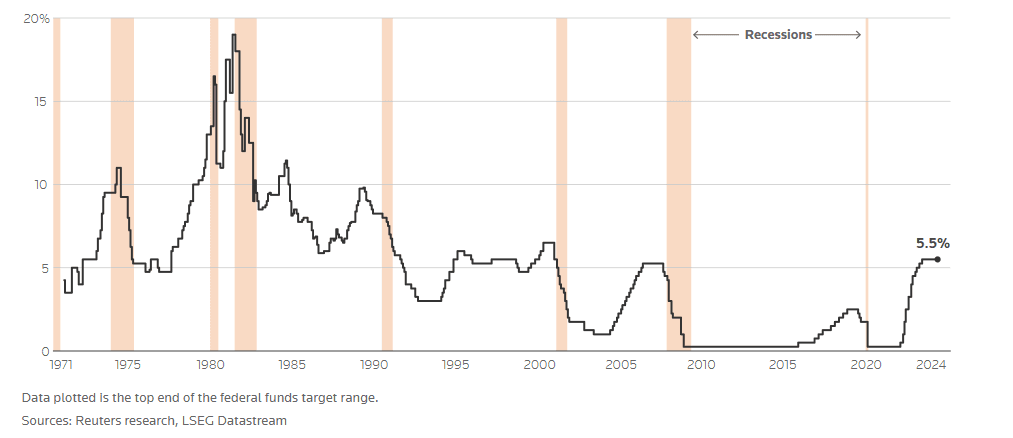
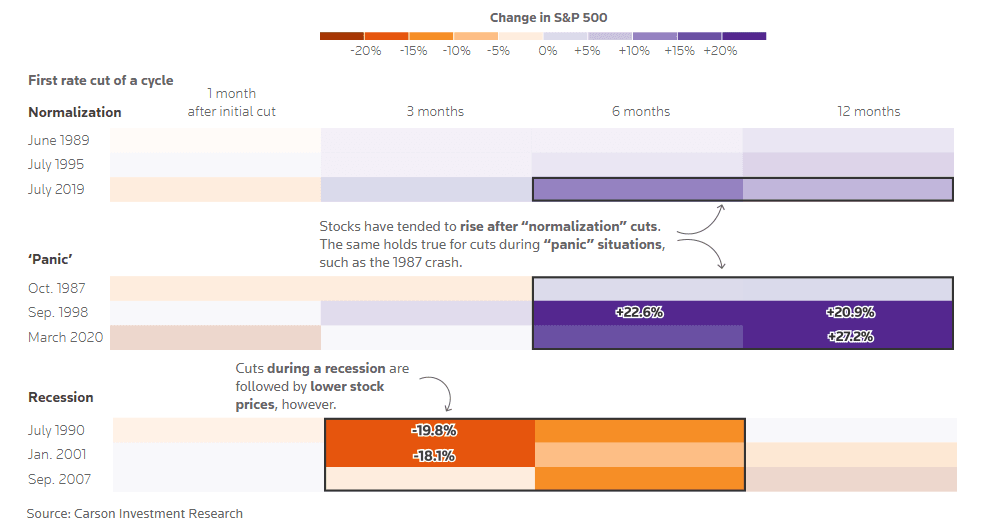
As the Federal Reserve has started a new rate-cutting cycle for the first time since 2020, to bring down borrowing costs from their highest levels in more than two decades, let us take a look at previous starts of such rate-cutting cycles.
The S&P 500 has historically corrected an average of 4 percent to the downside in the first six months after the first reduction of a rate-cutting cycle, if the economy was in a recession. That compares to a 14 percent gain for the S&P 500 when the Fed cut in a non-recessionary period. Recessions are typically called in hindsight by the National Bureau of Economic Research, and for now, economists see little evidence that the U.S. is currently experiencing one. Even though there are some signals indicating that a recession could be around the corner for the U.S. economy, there are arguments for and against a looming recession, but economists seem to agree that we are currently not in a recession. Time will tell whether this view will change in hindsight.