Listen to the Weekly Wrap on Spotify and Apple Podcasts. It is a summary with the help of AI-voices.


This Week’s Top Stories
“$47B in inflows for global digital assets in 2025, just shy of the 2024 record.” – Tuesday, 6 January 2026
- In 2025, digital assets saw $47.2B in net inflows, staying on track and ending the year just shy of the 2024 record. Interestingly, Bitcoin saw a sharp 35 percent decline in flows, bringing in $26.9B compared to $41.6B in 2024, while Ethereum flows more than doubled from $5.3B in 2024 to $12.7B in 2025. XRP and Solana also saw large increases in flows, both attracting around $3.5B each in 2025.
“MSCI decides to keep DATs in Indexes.” – Monday, 5 January 2026
- MSCI announced this week that, for the time being, the current index treatment of DATs will remain unchanged, following months of uncertainty for crypto-related equities, particularly the largest DAT, Strategy. MSCI also signaled that the exclusion of Strategy and other DATs remains on the table, but that more time is needed to determine the appropriate criteria for excluding non-operating companies that are primarily investment-oriented entities.
“Florida lawmaker filed a bill to create a strategic Bitcoin reserve managed by the state to fight inflation.” – Thursday, 8 January 2026
- Florida House Member John Snyder filed a bill to create a strategic Bitcoin reserve for the state, which would allow the state’s chief financial officer to invest up to 10 percent of key public funds in Bitcoin, Bitcoin ETFs, and other cryptocurrencies with a market capitalization of at least $500B. Currently, only Bitcoin meets this criterion. If voted on and signed into law, the bill would take effect on July 1, 2026.
A Quick Crypto Overview: 2025 Ended Red but Bitcoin is Currently Holding Steady
Bitcoin and the broader crypto market have essentially been trading more or less sideways since 21 November 2025, when Bitcoin bottomed out around the $80K level. The November bottom came in slightly higher than the April 2025 bottom, when Bitcoin traded as low as $74.5K. At the time of writing, Bitcoin is trading at $91K, up 13 percent over the past 50 days.
Bitcoin closed the year 2025 with a yearly loss of 6.6 percent, and the total crypto market cap ended the year down almost 8 percent, with Ethereum showing a yearly performance of minus 11 percent. Thinking back to the end of 2024 and the beginning of 2025, this price action has certainly disappointed many market participants, as sentiment going into the year was beyond bullish, with the new Trump administration laying the tracks for a full-steam crypto embrace and adoption.
Contrarian investors certainly had an easy job last year taking the other side of this trade. Going into 2026, however, sentiment has shifted, and many crypto market participants are uncertain about the new year and what it might bring for our beloved coins. While 2025 certainly surprised and disappointed to the downside, at least in terms of price action, 2026 might flip the switch and surprise to the upside. The groundwork has been done, crypto legislation is moving forward like never before, and as mentioned above, institutional money is pouring in. Once the OGs are done selling and supply dries up, Bitcoin appears to be in an interesting spot.
The alternative scenario, however, is that we are currently on the brink of a bear market. In this case, Bitcoin losing the $80K level and trading toward April’s $74K region would likely indicate a more muted period for crypto assets over the next few months.
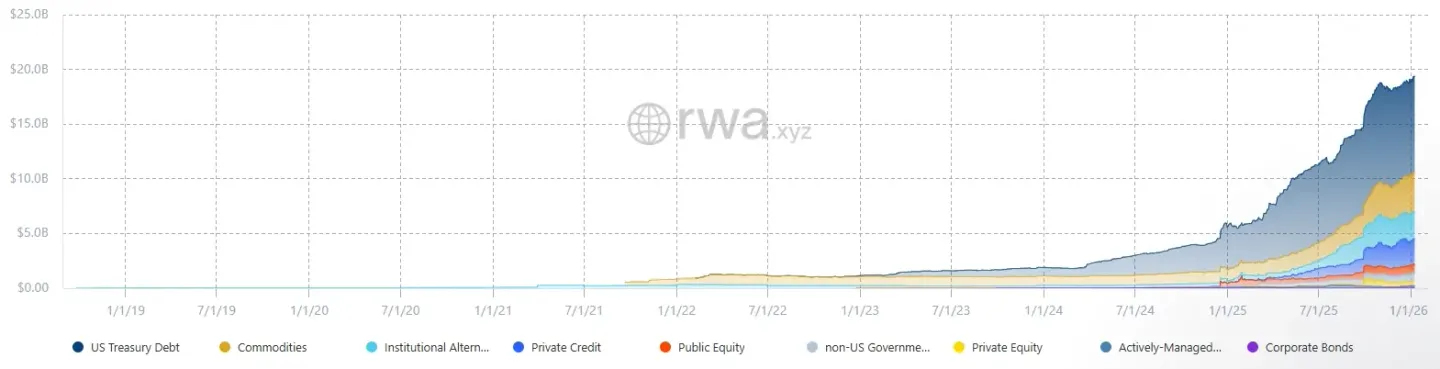
Chart of the Week: Tokenization Market has 10x’d Over the Past 2 Years
At the beginning of 2024, the total RWA value of all tokenized assets, according to rwa.xyz, was roughly $2B. Fast forward two years, and we are now sitting at $19B in tokenized assets, leaving the tokenization market with a clean 10x trade over the past two years. In 2025 alone, the total tokenization market increased from $5.6B to $19B within a year, showcasing one of crypto’s most promising and fastest-growing market segments at the moment.
It is important to note that stablecoins are not included in these numbers. Including stablecoins, the tokenization market is north of $300B, after having crossed this mark for the first time last year. Excluding stablecoins, U.S. Treasury debt makes up most of the market share, followed by commodities, institutional alternative funds, private credit, and public equity.