Listen to the Weekly Wrap on Spotify and Apple Podcasts. It is a summary with the help of AI-voices.


This Week’s Top Stories
“Meta to enter Stablecoin space later this year.” – Tuesday, 24 February 2026
- Anonymous sources stated this week that Meta, the parent company of Facebook, Instagram, and WhatsApp, has been in contact with third-party companies to help facilitate stablecoin-based payments within its apps. The move would represent a renewed interest in digital payments and stablecoins.
“Ethereum Foundation publishes ‘strawmap’ roadmap for Ethereum toward 2029.” – Thursday, 26 February 2026
- This week, Justin Drake introduced the “strawmap” roadmap, outlining seven proposed protocol forks through 2029, based on a cadence of roughly one fork every six months.
- The roadmap sets five long-term goals: faster L1, targeting finality in seconds; 1 gigagas/sec throughput; high-throughput L2 via data availability sampling; post-quantum cryptography; and native privacy-preserving ETH transfers.
“Terraform Labs sues Jane Street for alleged insider trading prior to Terra-Luna collapse.” – Monday, 23 February 2026
- The administrator overseeing Terraform Labs' liquidation has sued Jane Street, accusing the trading firm of engaging in insider trading that accelerated the Terra-Luna collapse back in 2022.
- According to Todd Snyder, Jane Street abused market relationships to rig the market in its favor during the escalation and de-pegging of TerraUSD. Snyder already sued Jump Trading in December, claiming that Jump actively exploited the ecosystem by entering into a backdoor deal to inflate the value of the algorithmic stablecoin TerraUSD before it imploded.
- Jump reportedly also appears in the latest complaint against Jane Street, as Snyder claims that some of the non-public information was leaked to Jane Street through Jump Trading.
A Quick Crypto Overview: A dump to start a volatile week in crypto
The week started with a dump during the night into Monday, as the crypto market started to sell off around 1 am Swiss time on Monday morning. Bitcoin continued trading to the downside until Tuesday afternoon before the US market open, where Bitcoin bottomed at around $62’500. Bitcoin has since recovered the entire correction and is currently trading higher than before the drop on Sunday night. Ethereum is currently trading above $2’000 and is up roughly 5 percent against Bitcoin since the Tuesday lows.
UNI and MORPHO continued to rally this week after the positive news catalysts we mentioned last week, with BlackRock and Apollo Global partnering with the crypto projects and buying tokens as part of the deals.
Roughly 80 percent of the top 100 cryptocurrencies are either positive on the week or trading flat, while coins such as ATOM, BCH, or ZEC are still down double-digit percentage points since Sunday. The total crypto market cap is up 8 percent from Tuesday’s low.
The US stock market is also looking back on a volatile week, with the S&P 500 slightly down on the week, trading at 6’900 at the time of writing. Gold traded flat this week, still hanging out around the $5’180 level after a quick spike to the upside on Monday, when gold traded at $5’250 for a couple of hours.
Over the past few weeks, there has been a lot of talk about IGV, the iShares Expanded Tech-Software Sector ETF, an index which has sold off quite heavily since October 2025. Interestingly, Bitcoin has been trading alongside the IGV ETF, which is currently also up 8 percent from its Monday lows. The IGV price action might be something to keep an eye on during the coming days and weeks, as many traders seem to focus on it in combination with Bitcoin and crypto in general.
Chart of the Week: “How to buy Bitcoin” on Google Trends
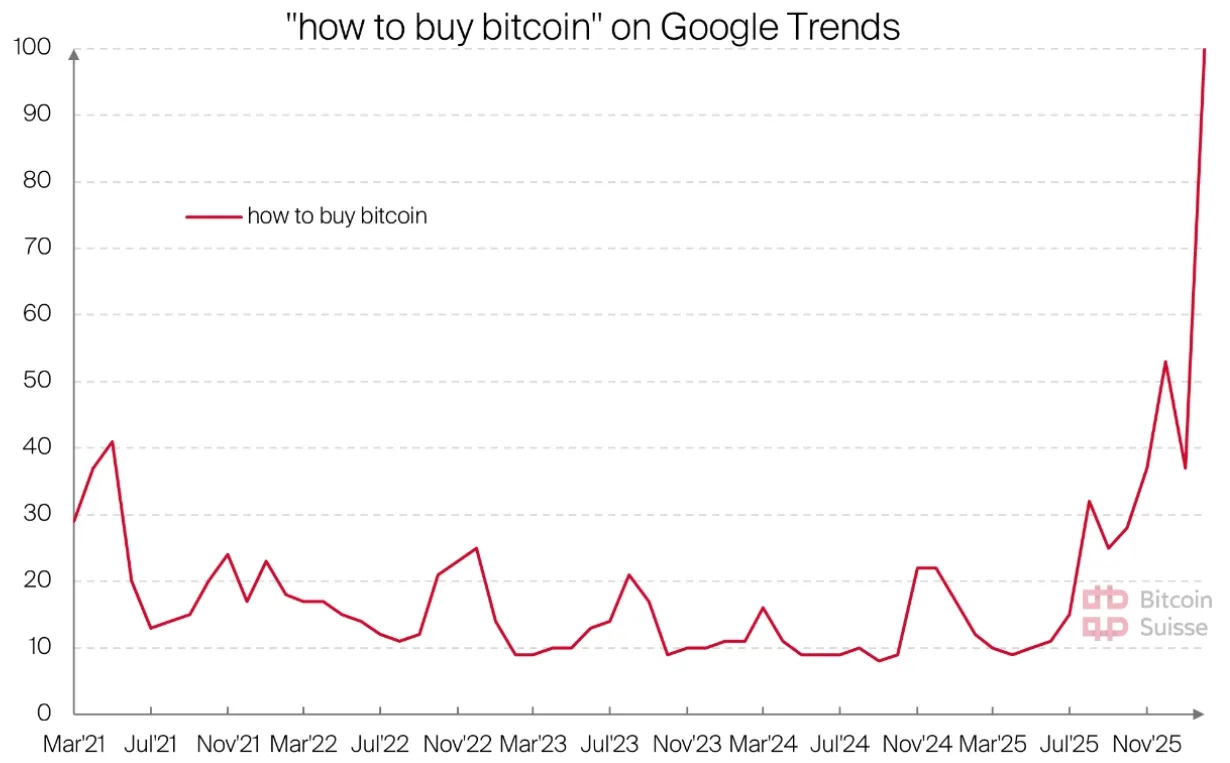
The number of Google searches for “How to buy Bitcoin” has been increasing steadily over the past few months and reached a new five-year high this month. Google Trends metrics are often used to gauge retail investor sentiment and interest in assets such as Bitcoin. When looking at the Google Trends data over the past 15 years, we can see that the largest spike and current all-time high for “How to buy Bitcoin” occurred in December 2017, at the end of the bull market. The second-highest number of searches was recorded in January 2021 amid the Elon Musk and Tesla news surrounding Bitcoin and Dogecoin during the great bull run of 2020 and 2021.
Now the question remains: is this recent spike in Google searches a bullish or bearish sign? As outlined above, there are arguments for both. In 2017, it marked the top of the bull run, but the market had traded essentially up only for a long period of time before the all-time high in Google searches was reached. In January 2021, it was essentially the start of the most explosive phase of the bull run, but it was also a completely different situation in terms of price action than right now, as Bitcoin had reached a new all-time high above $20’000 in December 2020.
It is an interesting observation, and time will tell how this will affect the market over the coming weeks and months. A drop in Google searches could be a first indication of fading interest. Let’s keep an eye on it.