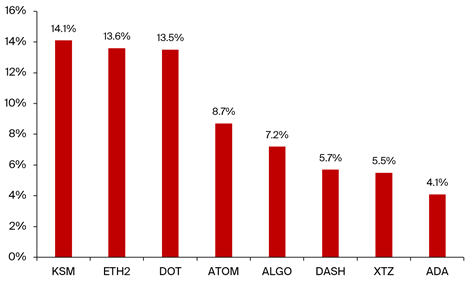
Inflation and utility tokens. Ethereum still looks good with these metrics: the platform with the highest market cap is also the one with the lowest inflation rate (under 1%), while some of the competitors exhibit 2-digit inflation rates that make fiat currencies look good. Does inflation matter at all? In contrast to a pure monetary coin like Bitcoin, which has an ever-decreasing inflation rates built-in, the question which inflation rate is adequate for a smart contract chain is less obvious
Low inflation may increase the token price (in fiat terms) over time, which is what investors seek. High inflation rates on the other side, may just mean that many tokens are created that users and developers can take to run smart contracts cheaply. The less a “gas” token is used as money, the better it is suited to power smart contracts and vice versa (aka utility token). It will be interesting to see how the differing interests between developers, users and investors will play out in the longer run – especially on the Ethereum platform that changes the economics quite radically.
Emergence of “ultrasound money”
Two developments impact the circulating supply of ETH on the path to Ethereum 2.0. One is caused by the switch to Proof-of-Stake (PoS), the other one was deliberately introduced to change the fee dynamics.
Proof-of-Stake is powered by validators who stake tokens (a bit like in poker) instead of spending energy for producing the next block and keeping the network secure. It’s a bit like poker: You put on a stake and if you lose (i.e., do not adhere to the consensus rules), your stake is slashed. How large will the effect be? Due to the various changes, the future monetary policy aka token supply for Ether is very hard to anticipate without modeling it.
No mining takes place in Proof-of-Stake. Instead, special nodes called validators, coordinate to process transactions and block creation by locking a minimum amount of Ether. This stake can be foregone if they behave malicious and manipulate the block creation process to their advantage. The protection lies in slashing of their stake and not in investing energy to create blocks.
What are the economic effects of staking on the supply? Most obvious, the circulating supply is reduced by the amount staked.
From December 2020 to November 2021, the amount of Ether staked for Proof-of-Stake on the Beacon Chain grew from 656 160 ETH to 8 391 388 ETH (+1280%), which permanently removes ca. 7% of the total circulating supply of ETH.
The question of supply dynamics is further complicated by the fact that the dynamics of the (“gas”) fee market in Ethereum have been modified significantly by activating EIP-1559 in the London hard fork. Before EIP-1559, the fee market was an auction in which users bid to get their transactions included by miners and all fees went to the miners. This change introduced a new mechanism of calculating fees per transaction and per block with a particular twist. Now, transaction fees consist of two parts: a mandatory base fee and an optional miner tip. While the miner tip continues to go to the miner, the base fee is burned. Since activation, the mechanism removed a total of 1,087,615 ETH from the supply through fee burning, reducing the net issuance by 507,000 ETH (68%) in the period August-November 2021.
Combined, staking and fee burning have a dampening effect on the supply of ETH. Some argue that with these changes, Ethereum is moving into a deflationary monetary policy that is stronger than Bitcoin’s inflation reduction over time, leading to “ultrasound money” in the end.
Discussion
Given the long history of exploits in the mainly Ethereum-based DeFi space and the approx. $1.5b loss of funds in 2020 and 2021 are testament to the fact that the crypto space is technically very demanding. While the number of web3 developers may still be limited, the number of computer science experts able to reliably analyze cryptographic protocols is vanishingly small.
In that context, Ethereum is headed for a fundamental transformation that turns the system upside down. The complexities and risks of dissecting the consensus components and spreading them across multiple chains are mind-blowing. A few aspects to keep in mind:
Complexity. The migration to Ethereum 2.0 is a complex undertaking with several moving parts that change simultaneously and are not easy to anticipate in their consequences: Merging to PoS, mapping Ethereum 1 into an execution shard, complex fee market dynamics, split into execution and multiple data shards, etc. How the cryptoeconomic dynamics will play out longer term is very hard to assess even with simulation.
Economics. Tightening the ETH supply because of staking may be good for investors, but it is less beneficial for those (many more) people who want to develop, run, and use smart contracts on Ethereum because it makes much more expensive measured in USD or other fiat currencies. Cheap gas is good for driving, not for investing in the oil industry.
The new fee mechanism exacerbates this trend. This strong limitation of the supply towards “ultrasound money” is a double-edged sword for a smart contract platform whose ambition is to be a world computer rather than a world currency.
Ethereum’s primary focus has always been to be the “world computer”, executing smart contracts and powering decentralized applications. However, as the recent price developments have shown, people also like to just invest in Ether as a “currency”, not worrying about developers and smart contract users per se. The interests do not seem to be fully aligned and we will see how the changing dynamics will work out in 2022 and beyond.
Finally, burning fees that users had to first earn/buy while validators receive newly created Ether as staking rewards is vaguely reminiscent of the Cantillon effect in fiat money systems: the ones “closest” to the money printer profit most of newly created coins while those at the end of the money trail have to deal with the reduction in value the market realized in the process. It will be important to watch the evolving monetary policy of Ethereum 2.0 as it is deliberately kept flexible.
Competition. All these changes promise a bright future for Ethereum, but the biggest short-term issue that is dragging users and developers to other platforms is not immediately addressed: high to very high transaction fees to run smart contracts for DeFi, NFTs, and other booming markets. Ethereum may be on the right track but may still not win the race against time.
Proof-of-Stake. While the mainstream opinion sees Proof-of-Stake winning the energy consumption debate, the more technical debate of whether Proof-of-Stake is as secure and immutable as Proof-of-Work is not so easy to decide.
Different points of criticism have been voiced in the past and we recommend consulting the cited sources for details. (1) Voskuil argues for the need for a source of security external to the blockchain because otherwise overcoming censorship is impossible should a censor reach the majority stake because it cannot be unseated anymore. (2) BitMEX’s “Guide to PoS” from 2018 already mentions the “Nothing at Stake” problem and the long range consensus attack. “Nothing at stake” means that in the case of two simultaneous blocks, a staker can use the same tokens to stake on both blocks, thus increasing rewards without additional risk to the detriment of convergence of the network to one single next block. In other words, stakers can easily change their mind and back different (fork) chains, while in PoW that would cost a lot of energy, so miners must make a decision and stick to it. Second, the long-range consensus attack problem is the problem that attackers could get hold of an “old” private key that held a large amount of tokens in the past. Simply using it to rewrite history in their favor is easy as there is no “energy wall” preventing catching up with the main chain. The solution, setting regular checkpoints, requires nodes to be online 24/7 or trusting other nodes for syncing when getting back online. (3) Nguyen is worried about Ethereum’s resilience in dealing with worst-case scenarios and gives a summary of PoS critiques, which we lack the space to dive into here.
Altogether, a few years into the Proof-of-Stake debate, the final verdict on the security merits is still pending. More research and debate are needed in our eyes to come to a clear understanding, analysis, and decision. The fact that the two largest permissionless blockchain protocols disagree on something as fundamental as the security models of the underlying consensus protocol should be a matter of concern to the crypto community.
Conclusion
Ethereum has embarked on an ambitious journey by performing the largest transformation of a blockchain project ever attempted. The stakes are high (no pun intended) as Ethereum is by far the largest smart contract platform in the DeFi space, with the most users, developers, funding, and buy-in. The switch to PoS and the separation into dedicated chains/shards is hands down the most ambitious attempt of Layer-1 scalability and will catapult Ethereum into another league if successful. At the same time, the staggering complexity and fundamental concerns raised by some experts cast doubt on the viability of the mega project.
Time will tell. Twelve months from now, we should have a much clearer picture of where Ethereum is going, and which will be the smart contract platform of choice for the crypto community.