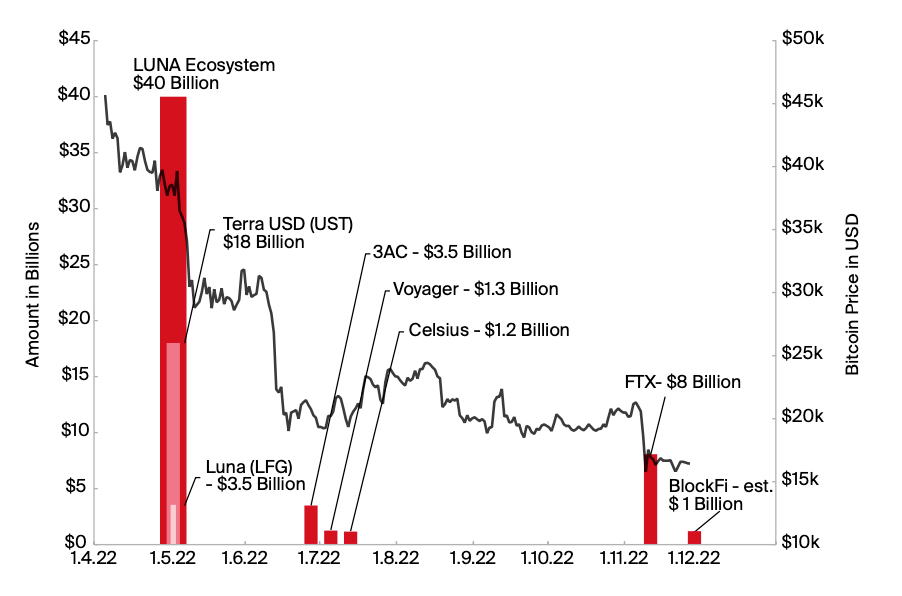
What does Lopp mean by that? Paper bitcoin means bitcoin you own but are not under your control. The “not your keys, not your coins” mantra resurfaced when FTX, the Luna Foundation Guard and other “safe custodians” turned out to not be so safe after all. The core problem is that it requires trust, that your bitcoin is not repurposed for other investments while you entrust the custodian with them. As this repurposing is the source of any yield you could ever get on bitcoin, it is also attractive to entrust a third party with your bitcoin. Many bitcoin were involuntarily sold in 2022 because the DeFi institutions who custodied them (as reserves or as client funds), had to sell them to redeem collateral, other tokens, that their clients enquired to withdraw, or to cover for losses in other investments. These leverage dynamics created additional, and in a sense unnecessary, sell pressure on Bitcoin. Without the maniac search for yield on Bitcoin, much less of this pressure would have been generated during the market downturns.
Why? Because Bitcoin is “money” and money does not offer yield because its purpose is to store value in uncertain times and be a medium of exchange in better times. In addition, holding a bearer asset like Bitcoin does not have counterparty or other risks except price volatility measured in fiat currency.
Despite all these pressures – from war, inflation, rate hikes, DeFi mistakes in large stablecoins, CeFi shenanigans – the Bitcoin network just kept chugging along: no bridges hacked, nobody had to put the “blockchain into maintenance mode”, transactions were processed every ten minutes on average and fees were bearable throughout the year. In fact, security of the network in the form of hashrate hit five all-time highs in 2022 and the number of nodes as an indicator of decentralization remained stable around 15’000 public nodes (and an unknown number of private nodes on the TOR network).
Short-term investors or recent entrants (since “peak bull” in 2021) have experienced quite a bit of pain – like everybody who joined just before a “-80%” period in the history of Bitcoin. If you think the fundamentals of Bitcoin are intact, and we think they are, then a long-term perspective does this “money experiment” more justice. For such a perspective and in such volatile times, qualitative information about ecosystem developments is more telling for the future than historical charts. So, let’s see...
To watch: nation-state adoption. While user adoption of Bitcoin has slowed in the 2022 bear market, it remains above pre-bull market levels with the top 20 adoption countries covering all continents[48].
After El Salvador in Central America (06.09.2021), the Central African Republic (CAR) is the first country on the African continent that introduced Bitcoin as legal tender on 23.04.2022. Both countries depend on a for- eign currency: while El Salvador is dollarized[49], the CAR is using one of the two CFA franc (Franc of the French Colonies in Africa) currencies that are in use in 14 former French colonies in Western and Central Africa[50]. As the CFA franc is pegged to the Euro, these countries struggle with economic planning as the monetary policy for them is made in Brussels and the Euro peg makes exports more expensive as they cannot actively manage adequate exchange rates. No wonder, the Machankura project enables Bitcoin Lightning transfers via SMS across eight African countries to counter the lack of internet connectivity[51].
Despite the bear market, El Salvador is continuing its Bitcoin journey and holds 2480 bitcoin at time of writing[52]. On November 17, 2022, the president announced that the country is buying one bitcoin every day. Addressing the primary criticism that citizens have been hit unprepared by the legal tender law in 2021, the NGO ‘Mi Primer Bitcoin’ has started to educate 11’000 students on Bitcoin in 2022, with plans to extend the offering to 250’000 in 2023. They also created a school curriculum in which students can receive a “Bitcoin diploma” in several public schools, with the aim to reach all schools in the country.[53]
In May 2022, El Salvador hosted the annual meeting of the Alliance for Financial Inclusion to discuss Bitcoin for nations with 32 central banks and 12 financial authorities in attendance from a range of countries: Paraguay, Haiti, Honduras, Costa Rica, and Ecuador in Latin America, Angola, Ghana, Namibia, and Uganda in Africa, and Bangladesh, Palestine, and Pakistan in Asia[54].
Since December 2022, Bitcoin is recognized as a means of payment and investment asset in Brazil, with the law going into effect in summer 2023[55]. While the law does not render Bitcoin or other cryptocurrencies legal tender, the greater regulatory clarity may encourage businesses to explore it more closely – Brazil is currently the top 7 country in crypto adoption[56].
A second aspect of nation state adoption would be to adopt Bitcoin as a part of the national currency reserve strategy. No country has yet publicly spoken about using or considering the use of Bitcoin in that way – although you could argue El Salvador’s Bitcoin stack is more of a reserve than investment money for the time being. In a working paper from Harvard, Matthew Ferranti explores the potential of Bitcoin to serve as an alternative hedging asset compared to gold, which was bought 2016-2021 by countries who faced a higher risk of US sanctions[57]. Coming from a student of Kenneth Rogoff, Harvard economist and Bitcoin critique, it was a bit of a sensation. A group of shareholders of Swiss National Bank also suggested in the 2022 general assembly that the SNB prepares for taking on bitcoin as part of its reserves. Reserves in bitcoin could not be confiscated nor otherwise tampered with as is possible with fiat currencies. For example, Russia’s foreign currency reserves including gold were frozen, i.e., not accepted anymore for debt payments after Russia was also disconnected from SWIFT[58].
To watch: green energy contribution. Energy grids pose delicate management challenges. Energy supply must follow demand changes as instant as possible to prevent blackouts or waste of excess energy. The grid is therefore composed of a range of energy producers: from slow reacting but large base load providers up to very fast, but usually small peak load providers. For the same reasons, the same flexibility is desired on the demand side. In tight situations, grid operators ask large industrial consumers to switch parts of their machines off. Again, the larger the machines, the slower they are in reacting.
This is where Bitcoin mining comes in. In the words of the Bitcoin Policy Institute[59]: “Proof-of-work mining has complex and dynamic effects on global energy systems. While mining uses substantial amounts of electricity — currently 0.18% of global energy — it is price-sensitive, interruptible, adjustable, and location-agnostic, which pairs well with intermittent renewable energy sources like wind and solar, as well as stranded sources of energy like waste methane.”
The electricity consumption of Bitcoin is substantial, however, considerably less than of those industries relevant to the fiat monetary system: military-industrial complex[60] (30-60x of Bitcoin), banking/finance (22-50x of Bitcoin), and gold mining (2-5x)[61].
The properties of Bitcoin mining make it uniquely qualified as a location-agnostic, very fast-reacting and yet large energy consumer to support the stabilization of energy grids. Mining can be leveraged in three ways to help decrease emissions of existing fossil sources of energy and increase the fraction of renewable sources of energy.
- First, to prevent blackouts, energy grids tend to overproduce. In the case of fossil sources of energy, this not only leads to energy waste but also unnecessary additional emissions. Bitcoin mining can help to reduce emissions by mitigating methane and CO2 emissions from landfills and flaring/venting of excess gas at refineries. Instead of emitting into the atmosphere, they are used to generate power to run a mining operation. Bitcoin mining helps reducing emis- sions and supports the financing of such oper- ations[62].
- Second, grids are increasing the fraction of renewable sources[63]. As renewables are inter- mittent sources (sun does not shine always, wind does not blow always), they contribute to grid volatility, thus making it harder to keep grids stable compared to fossil power plants that provide stable base load. In such situations, Bitcoin mining can help finance the increase of renewables, location-agnostic, while decreasing volatility and preventing blackouts[64].
- Another large source of clean energy that deserves a bigger role in the energy transition according to the International Energy Agency is hydropower[65]. Bitcoin mining can support the financing of more hydropower operations[66].