Listen to the Weekly Wrap on Spotify and Apple Podcasts. It is a summary with the help of AI-voices.


This Week’s Top Stories
“U.S. Producer Prices Unexpectedly Fell in August, while Consumer Prices Came in as Expected.” – This week
- The U.S. PPI came in surprisingly lower than expected, at 2.6 percent versus the expected 3.3 percent. Month over month, the PPI fell 0.1 percent, down from the previous reading of 0.9 percent. The CPI data release on Thursday, however, came in slightly higher than expected at 0.4 percent month over month, versus the expected 0.3 percent. The Fed is more focused on the Core CPI number, which came in as expected at 0.3 percent. The broad increase in inflation likely somewhat reflected businesses passing on higher costs from Donald Trump's tariffs to consumers.
- At the same time as the inflation data, the U.S. Labor Department released a higher-than-expected initial jobless claims figure, which came in at the highest level since October 2021, further showing signs of a weakening U.S. labor market.
“The Inflation Figures This Week in the U.S. Were the Last Hint Before the Fed Interest Rate Decision Next Week.” – This week
- The Federal Reserve is expected to cut interest rates by 25 basis points in their meeting next week, and the new inflation data is unlikely to change that. The market is currently expecting a 25-bps cut with a probability of 91.8 percent, versus an even higher cut of 50 bps with a probability of 8.2 percent.
- Chances of a 50-bps cut were at zero percent last week but have increased since the job data release at the end of last week, which showed cracks in the U.S. job market, as the July job report came in weak and annual revisions to nonfarm payrolls data for the year prior to March 2025 showed a drop of 911’000 from the initial estimates.
- With more than $7 trillion sitting in money market funds, lower interest rates have historically led to some of this money being rotated into other instruments, such as the stock market or potentially alternative asset classes such as crypto.
A Quick Crypto Overview: U.S. Stock Indices and Gold at ATHs, and Crypto Starting to Catch Up
The markets are up this week after the inflation data came in from the U.S., and participants continue to expect interest rate cuts by the Fed next week. Bitcoin is trading above $115’000, Ethereum is sitting above $4’500, and Solana is up more than 15 percent this week. The S&P 500 reached a new all-time high yesterday just below the 6’600 mark, while gold also traded at all-time highs this week, hitting $3’675 on Tuesday.
Bitcoin dominance continues to trend lower, giving room for some explosive movements in the altcoin market, with PUMP up 35 percent, Mantle up 35 percent, and PENGU up 30 percent this week alone.
While a large portion of the top 100 crypto assets is still slightly down over the past 30 days, September has certainly started off on a positive note, with the total crypto market cap increasing by almost 7 percent since the beginning of the month.
September seasonality bears seem to be on the wrong side of the trade so far. It remains to be seen whether the Fed's interest rate decision next week will be a “sell the news” event or a continuation of the trend to the upside.
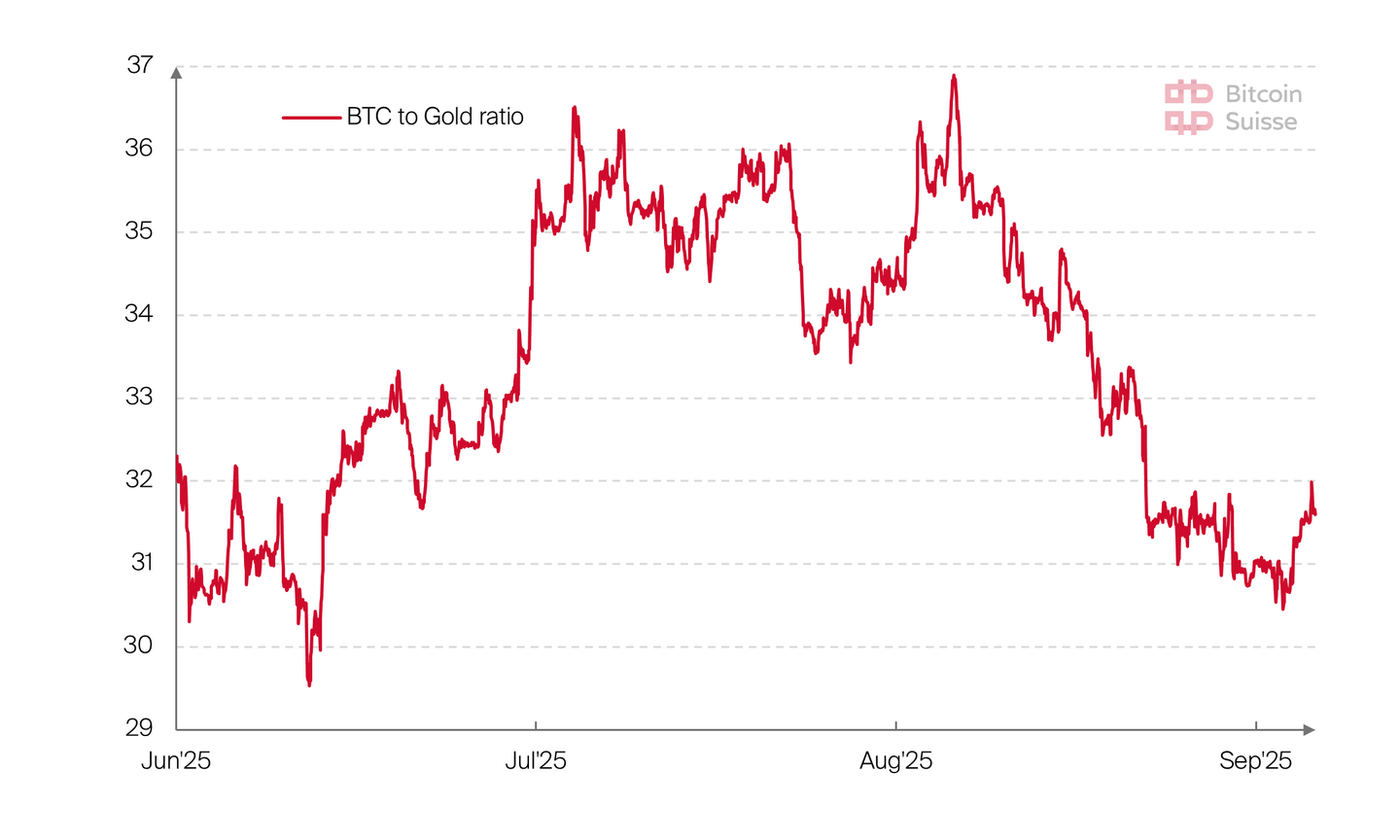
Chart of the Week: BTC to Gold Ratio – Will the Digital Version Finally Catch Up?
Gold is trading at all-time highs as central banks worldwide—such as China and various BRICS nations—have been increasing their gold reserves over the past months and years, aiming to diversify away from USD-based reserves. China has been on a gold-buying spree, raising its reserves for ten consecutive months to more than 74 million fine troy ounces by the end of August, while BRICS nations are in their third straight year in which annual purchases have exceeded 1,000 metric tons.
Given this acceleration in gold accumulation by central banks, one might wonder: what does this mean for Bitcoin? Compared to gold, Bitcoin is currently trading 20 percent below its all-time high from back in December 2024. Interestingly, BTC/Gold is also trading lower than it was back in 2021. However, the recent price action over the past few days is showing some signs of relief. Is it time for the digital version to finally catch up with its physical big brother?