Listen to the Weekly Wrap on Spotify and Apple Podcasts. It is a summary with the help of AI-voices.


This Week’s Top Stories
“Jerome Powell: Banks Can Serve Crypto Clients as Long as They Can Manage the Risk. And the Fed Is Not Against Innovation.” – Wednesday, 29 January 2025
- While the Federal Reserve announced that the target range for the federal funds rate will remain unchanged at 4.25 – 4.50 percent, which was in line with expectations, an adjustment in the FOMC minutes briefly spooked the market. However, Jerome Powell was able to calm the uncertainty during his press conference following the release.
- The crypto community was of course more focused on his remarks about digital assets. He stated that the Fed is not against innovation when asked about crypto. He also mentioned that he believes it would be helpful to have a more robust regulatory framework for crypto, as this would provide greater certainty for large banks to step into the space.
“The DeepSeek Saga – What Happened This Week?” – Monday, 20 January – Friday, 31 January 2025
- DeepSeek R1 Launch: Interestingly, DeepSeek launched its R1 advanced reasoning model on Monday, 20 January 2025, and claimed it rivaled OpenAI’s o1 product on several benchmarks, despite being created with far less funding.
- No. 1 Spot on the Appstore: On Saturday, 25 January, the DeepSeek mobile app took over the number one spot in the App Store in the U.S., U.K., China, Canada, and other countries around the world. This is when the story really gained traction, and uncertainty began to rise regarding the potential implications for the U.S. stock market, specifically in the AI sector.
- “AI’s Sputnik Moment”: Prominent investors began to speak about DeepSeek. Marc Andreessen tweeted that DeepSeek’s R1 model is AI’s Sputnik moment. These comments spooked the markets when the U.S. futures market opened on Sunday evening CET. The Bitcoin and crypto markets also traded to the downside, with BTC down over 7 percent overnight until Monday morning.
- A bloody Monday On Wallstreet: The DeepSeek news really hit the market at the open on Monday. Nvidia lost more than 12 percent at the market open, alongside other big chip stock companies such as Broadcom and Taiwan Semiconductor Manufacturing Company.
- The Worst Daily Percentage Loss Since March 2020: Monday marked the Nvidia's worst daily percentage loss since March 2020, losing more than $589 billion in market capitalization on a single day – the biggest one-day loss in U.S. history.
- Rebound Tuesday: On Tuesday, Nvidia and the U.S. stock market rebounded, with Nvidia posting the second-best day ever for any stock in terms of market value added in a single day.
- Did DeepSeek Use OpenAI’s Models For Training? On Wednesday, White House AI Czar David Sacks told Fox News that there was substantial evidence suggesting DeepSeek had used OpenAI’s models to train its own, which would be a breach of OpenAI’s terms of service.
- The Saga Continues: Nvidia traded to the downside again on Wednesday but recovered some of its losses on Thursday. It is currently down 12 percent since Friday and flat for the week. The story continues…
“Favorable Capital Gains Signaled For U.S. Crypto by Eric Trump.” – Monday, 27 January 2025
- On Monday various sources communicated that Eric Trump allegedly confirmed U.S.-based crypto projects would be exempt from capital gains tax. The 30 percent capital gains tax would apparently be imposed on non-U.S.-based projects.
- With this tax advantage, U.S.-based cryptocurrency projects could secure a competitive edge over offshore counterparts, potentially accelerating customer acquisition and boosting adoption.
- The most mentioned and largest U.S.-based projects include, among many others, XRP, SOL, AVAX, LINK and SUI.
A Quick Crypto Overview: Consolidation Below December’s High
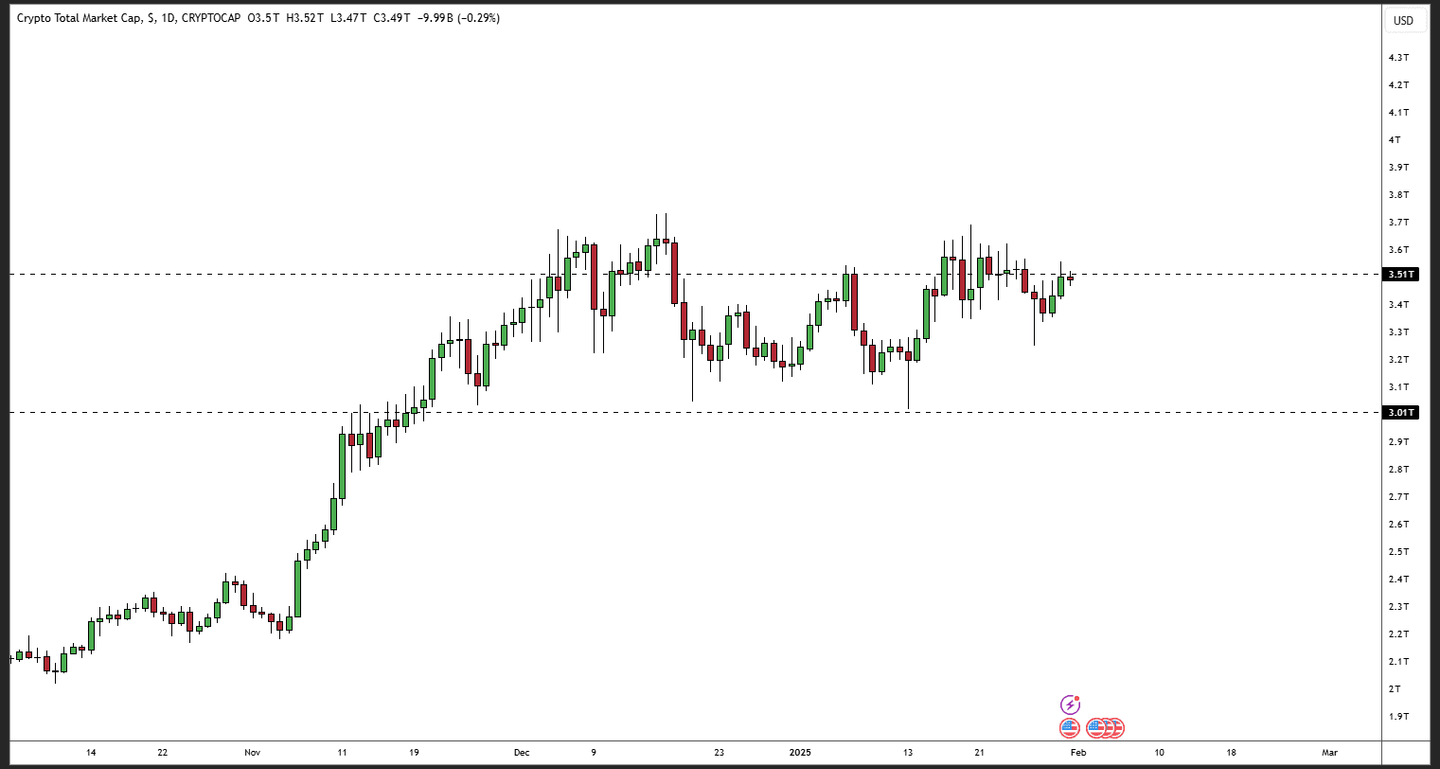
When looking at the total market capitalization, the chart shows a period of consolidation below December’s high, and the total market cap is currently fighting at the $3.51 trillion level, which was where it was rejected at the beginning of January, as the chart below shows.