• Home
  • Industry Blog
  • The Weekly Wrap: Extreme Fear Levels Not Seen Since 2022, Billions in Liquidations & Other News
1685355112644.jpeg
Luca Gnos

The Weekly Wrap: Extreme Fear Levels Not Seen Since 2022, Billions in Liquidations & Other News

06/02/2026 - 7 min read

Listen to the Weekly Wrap on Spotify and Apple Podcasts. It is a summary with the help of AI-voices. 

Listen_on_Spotify.png       Listen_on_ApplePodcast.png

This Week’s Top Stories

“Trump announces Powell’s successor, Kevin Warsh.” – Friday, 30 January 2026 

  • Last Friday afternoon, US President Donald J. Trump announced he is nominating Kevin Warsh as Chairman of the Federal Reserve Board.
  • During his previous five-year term as a Fed governor, Warsh earned a reputation as an inflation hawk and a critic of the Fed's large-scale bond holdings, used to help lower mortgage and other long-term interest rates as a permanent tool of monetary policy.
  • In recent months, Warsh has advocated for lower rates, arguing that an AI induced GDP boom is setting the stage for speedy growth without troublesome inflation, publicly agreeing with Trump that the Fed should sharply lower interest rates.

“Due to the House being in recess, the US government entered a technical, partial shutdown last Saturday.” – Saturday, 31 January 2026 

  • The US government went into a technical, partial shutdown on Saturday evening after a funding bill failed to pass in time. While the Senate approved a $1.2 trillion appropriations package, the House was in recess and did not vote on it until early this week, passing the package on Tuesday and ending the shutdown after just two days.
  • Trump and Democrats now have two weeks to strike an agreement on how to rein in federal law enforcement, specifically Immigration and Customs Enforcement, or face another shutdown for the department, which includes agencies from TSA to FEMA.
A Quick Crypto Overview: The worst BTC daily candle since FTX

The crypto market continued to trade to the downside last weekend, with Bitcoin losing more than 5 percent on a low volume Saturday evening, after already trading to the downside during the previous week. Saturday’s downturn shook up the markets quite a bit, and while there was a period of sideways price action at the beginning of the week, many market participants already feared the worst. 

As we mentioned in last week’s Wrap, a sustained move below the $80’000 level was the signal for another acceleration to the downside, and the correction continued yesterday, Thursday, with Bitcoin closing the day with a 14 percent loss, the highest daily loss since the FTX collapse back in November 2022. 

At the time of writing, Bitcoin is down 15 percent on the week, Ethereum is down 16 percent since Sunday, and Solana has a weekly loss of 21 percent. Let’s look at some of the possible catalysts behind this recent correction. 

The last few weeks were packed with new developments in various areas, be it geopolitical, macroeconomic, or crypto-specific. Recent months have seen significant selling pressure from long-term BTC holders, accompanied by the drying up of ETF and DAT flows, all while the crypto market still seems to suffer from the consequences of the 10/10 crash. Let’s dive into some of the most recent headlines below.  

Trump announces Powell’s successor Kevin Warsh 

While we expect Warsh to be stimulative for lower than consensus rate cuts, he is strongly opposed to FED balance sheet expansion/QE, that can play a vital role in upside momentum. We overall view the new FED nominee as constructive for digital assets. 

Market structure bill delayed as crypto industry continues to clash with banking lobby 

Over the past two weeks, it became increasingly clear that a decision on the CLARITY Act will likely be pushed back several weeks as key lawmakers shift their focus to potential housing legislation in support of President Donald Trump’s affordability push. On January 14, Brian Armstrong, Coinbase CEO, announced that the company is pulling its support for the bill as written. He mentioned various amendments that would de facto ban tokenized equities or kill rewards on stablecoins as the reasoning behind the decision. Should stalled negotiations resolve and clarity be passed into law, it could serve as a potential catalyst for digital assets. 

Bitcoin Hash rate is taking a hit as miner exodus accelerates 

Bitcoin’s total network hashrate has dropped significantly over the past few months in its largest decline since 2021, after severe US winter storms forced major miners to shut down operations. The hashrate has fallen roughly 25 percent from its high. The winter storm has reinforced an existing trend, as mining firms are repurposing facilities for AI data centers, where margins are higher and revenue is more stable than in BTC mining. The recent decline in Bitcoin’s price has had a direct impact on the profitability of miners, and many of them are currently operating under stressed conditions.  

Digital asset investment product flows 

The last two weeks were accompanied by large outflows from digital asset investment products, flipping YTD flows to a net outflow of $1 billion and a decline of more than $70 billion in AuM since the October 2025 highs. Across the major crypto assets, the negative sentiment last week was broad, with Bitcoin seeing $1.32 billion in outflows, Ethereum $308 million, while recent favorites XRP and Solana also saw outflows of $43.7 million and $31.7 million, respectively. 

Crypto liquidation figures 

Over the past weekend, more than $2.5 billion was liquidated, mostly on the long side. While $2.5 billion is a large number of liquidations, the third largest since the beginning of 2025, it still does not come close to last October’s total liquidation amount of almost $20 billion on October 10, 2025. Nonetheless, Saturday’s liquidation event has entered the top 10 largest crypto liquidation events of all time. During the past 24 hours, an additional $2.6 billion were liquidated from the markets, again mostly long positions, with $2.1 billion in longs and $475 million in shorts wiped out by the correction. 

Chart of the Week: Hyperliquid

One of the projects standing out over the past two weeks is Hyperliquid, with the HYPE token up more than 60 percent since 21 January 2026. The Hyperliquid team has recently made headlines. For example, HIP-3 markets reached new all-time highs of $1B in open interest and almost $5B in 24-hour trading volume this week, up from the previous all-time high of $800 million in open interest last week. HIP-3 allows HYPE stakers holding a minimum of 1 million HYPE tokens to launch perpetual futures markets on the Hyperliquid blockchain. Providers such as Kynetiq, with their product Markets.xyz, have started launching various RWA perps, and the recent hype surrounding commodities and onchain stocks trading led to a significant increase in volume and open interest on Hyperliquid. 

The recent market activity led to increased trading volumes on Hyperliquid, which in turn resulted in large amounts of fees on the platform, with $7.5M in 24-hour fees and $32.5M over the past seven days. Due to Hyperliquid’s revenue flywheel mechanism, most of these fees directly benefit token holders through the buyback and burn program

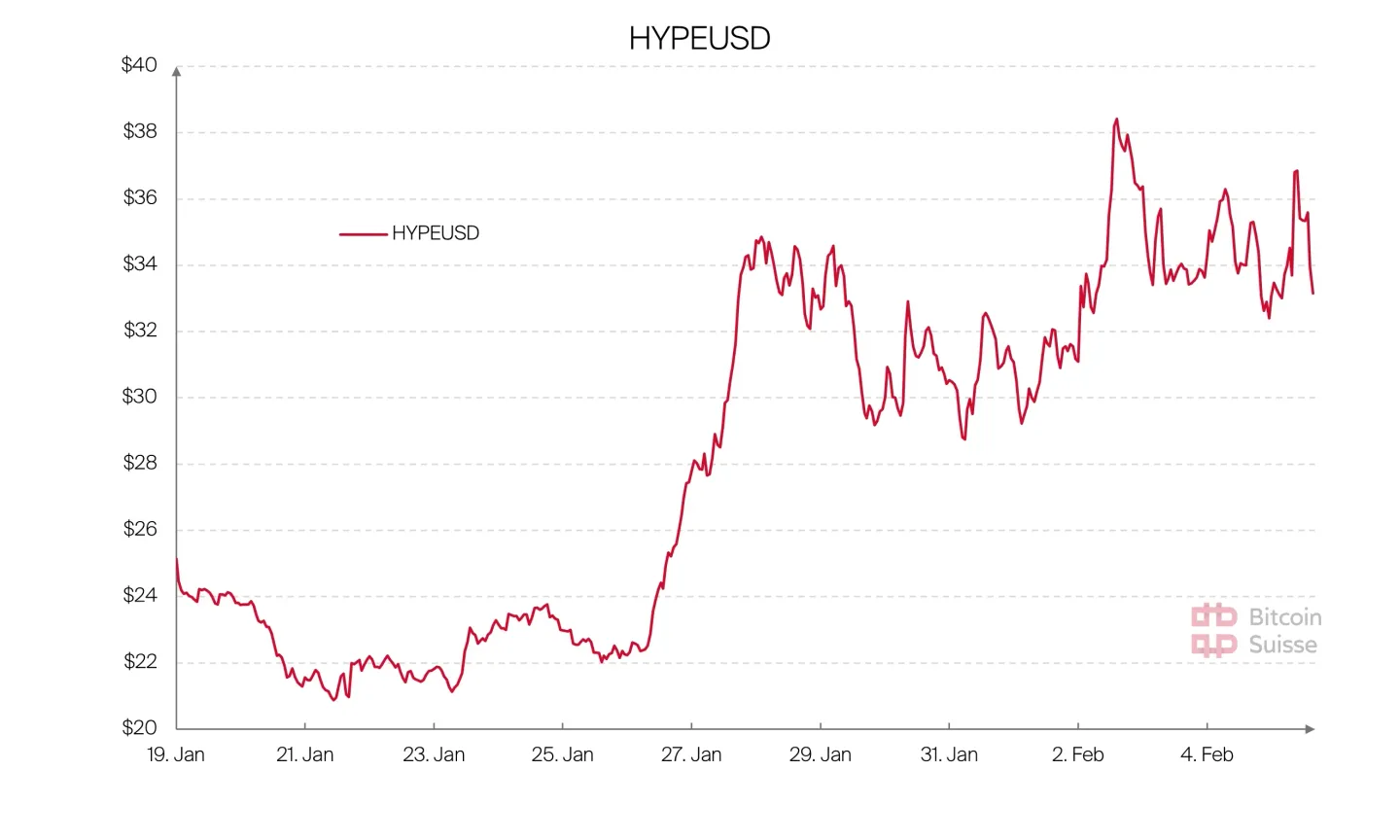
Chart: Bitcoin Suisse, data: TradingView as of 6 February 2026
What’s Happening Onchain? Vitalik on L2s, Hyperliquid and Coinbase enter Prediction Markets & Perp DEXs with second highest trading volume day in history

Vitalik made some headlines on X this week with a post regarding his thoughts on L2s. Vitalik stated that the original idea was that L2s would act like extensions (“branded shards”) of Ethereum, handling most transactions while inheriting Ethereum's full security. He now thinks that this vision is outdated for two reasons. First, the L1 is now scaling on its own, with significant gas limit increases planned. Second, L2s have been slow to reach full trustlessness (Stage 2), and some even say they may never want to. Vitalik argues that this is fine and proposes a new framing. Let’s look at some key takeaways: 

  • L2s should stop being seen as "mini-Ethereums" and instead find their own unique value, whether that is privacy, ultra-low latency, non-EVM features, AI or social use cases, or extreme scaling beyond what even an expanded L1 can offer.
  • Ethereum L1 is scaling directly, so L2s are no longer needed solely for throughput. The gas limit is set to increase significantly in 2026.
  • L2s should be Stage 1 at a minimum, meaning real security guarantees and not just a multisig bridge, if they handle ETH or Ethereum-based assets. Otherwise, they are effectively a separate chain.
  • A "native rollup precompile" is proposed, a built-in Ethereum feature that verifies ZK-EVM proofs. This would allow L2s to achieve trustless, security-council-free verification and seamless interoperability with Ethereum, while still being free to add their own custom features on top.
  • Users should know what guarantees they actually have. In a permissionless ecosystem, some L2s will be more secure than others, and transparency about trust assumptions is key.

In the world of prediction markets, Hyperliquid announced this week that HyperCore will add outcome trading via HIP-4, introducing fully collateralized, range-settled contracts for use cases such as prediction markets and bounded options, without leverage or liquidations. Additionally, Coinbase launched a prediction markets platform, allowing users to bet on sports, politics, crypto, culture, and other real-world events. Coinbase Predict is available in all 50 US states. Also this week, Polymarket’s parent company, “Blockratize”, filed a trademark for $POLY, giving Polymarket users an additional chunk of hopium for a potentially forthcoming token. 

As mentioned earlier, yesterday was a high-volume day overall and also on perpetual DEXs, which recorded the second-highest daily trading volume, topping $70 billion and taking second place behind 10 October 2025. Hyperliquid logged $24.7 billion in volume that day, followed by Aster at $10.0 billion, edgeX at $8.7 billion, and Lighter at $7.5 billion. 

Digital Asset Fund Flows: Outflows Accelerated last week and continue this week

Digital asset investment products saw net outflows of $1.7 billion last week. As mentioned before, these outflows brought year-to-date net flows to a total of $1 billion in net outflows so far in 2026. The outflows have continued this week, as the Bitcoin spot ETFs have seen more than $1.2 billion in net outflows since Tuesday. The Ethereum spot ETFs are currently sitting on roughly $150 million in net outflows so far this week. 

On another note, Binance announced that it will adjust the asset structure of its SAFU Fund, gradually converting the original $1 billion in stablecoin reserves into Bitcoin reserves, with the conversion to be completed within 30 days from the date of the announcement. Onchain data shows that the Binance SAFU Fund address initiated an authorization transaction to add two new addresses to its “approved recipient whitelist,” possibly in preparation for increasing its Bitcoin holdings. According to Arkham, Binance’s SAFU fund has purchased roughly 6’200 BTC, currently worth $410 million so far. 

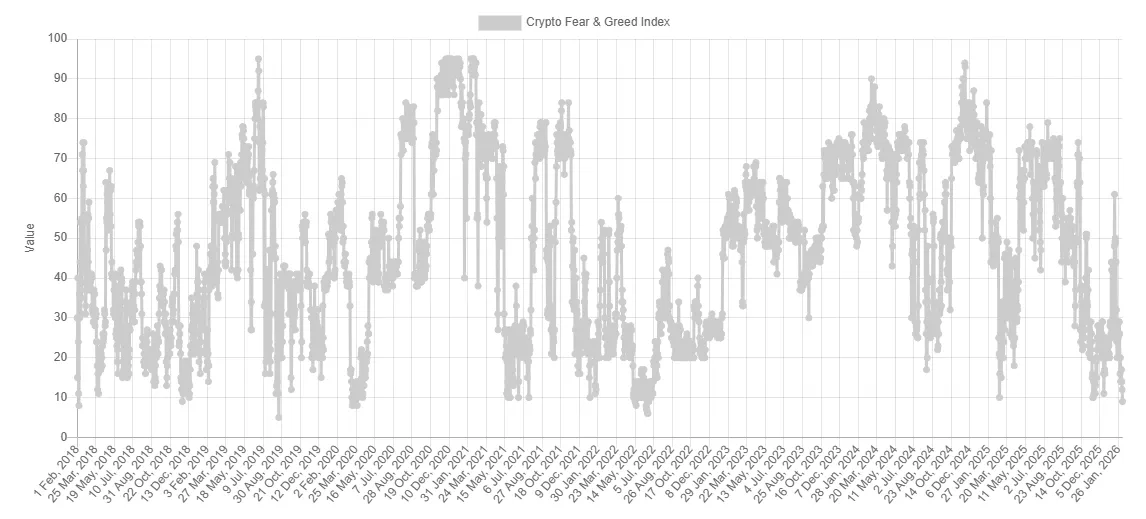
Market Sentiment: Extreme Fear (9) the lowest since June 2022

The crypto fear and greed index dropped below 10 to the lowest level since June 2022, amid the 3AC and Luna disaster during the last bear market. Sentiment is even lower than during the FTX crisis, despite BTC prices still being at multiples of levels seen back then. Interestingly, the CNN stock market fear and greed index dropped sharply since last week and is now in fear territory, after greedy readings last week. The number of bullish AAII members also dropped below 40 percent this week, while the number of neutral members increased from 24 to 31 percent. The number of bearish members dropped as well, to 29 percent.

Source: Alternative.me
Other Relevant News 
  • According to MLM monitoring, wallets suspected to be linked to Multicoin Capital appear to be swapping ETH for HYPE. – Link 
  • Several US public pension funds are facing significant losses due to investments in Strategy. – Link
  • Polymarket posted on X that it will partner with USDC, and that Polymarket user balances will soon be backed 1:1 by US dollars. – Link  
Looking Ahead: Bitcoin is currently below the 2021 High 

It was well worth it to be on the cautious side over the past few weeks. In the Wrap from January 16, we highlighted the risk of Bitcoin breaking below the $90’000 level and that a move like this would open the gates for significantly lower prices. In the Wrap from January 23, we highlighted that Bitcoin had broken down below $90’000 and that the chances of a deeper correction were increasing. Last week, we stated that a sustained move below $80’000 would likely lead to a continued downward trend toward $74’000, the April 2025 low. Today, Bitcoin is trading at roughly $66’000 at the time of writing, having even broken the lows from last April and trading around the same level as in early spring 2024, below the 2021 high of $69’000. 

Bitcoin is currently down about 48 percent from its most recent ATH, and market sentiment is as low as during the deepest bear market in 2022, at levels not seen during more than a handful of periods in Bitcoin’s history. 

While there is, of course, still a chance for a move lower, the probabilities seem to have shifted somewhat, and some market participants are starting to look for entries again, even if it is just for a relief rally. A consolidation around the $61’000 level could likely lead to a short-term rally toward last April’s low around $74’000.  

Should Bitcoin break below $60’000, however, the August 2024 lows from the yen carry trade unwind around $49’000 seem to be on many traders’ radar. 

Below, you can find some of the key data releases and events to watch out for next week. 

Tuesday, 10 February 2026 

USA – Retail Sales, Core Retail Sales 

Wednesday, 11 February 2026 

China – CPI, PPI 

USA – Nonfarm Payrolls 

Thursday, 12 February 2026 

Great Britain – GDP 

USA – Initial Jobless Claims 

Friday, 13 February 2026 

Switzerland – CPI 

Eurozone – GDP, Employment numbers

1685355112644.jpeg
Luca Gnos