Listen to the Weekly Wrap on Spotify and Apple Podcasts. It is a summary with the help of AI-voices.


This Week’s Top Stories
“Institutional Adoption in the U.S. Is Moving Forward Rapidly.” – This Week
- The New York Stock Exchange (NYSE) partnered with Securitize to develop a 24/7 tokenized securities trading platform. Securitize will act as NYSE’s first digital transfer agent, enabling shares of stocks and ETFs to be issued onchain.
- Franklin Templeton and Ondo Finance announced a partnership to launch tokenized ETFs tradable 24/7 via crypto wallets without brokerage accounts. The products will cover U.S. equities, fixed income, and gold, initially launching outside the U.S. only. Ondo issues tokens via an SPV representing return rights, usable as collateral and in DeFi.
- Coinbase partnered with Better to offer the first crypto-backed mortgages backed by Fannie Mae. This first-of-its-kind mortgage product expands access to homeownership while benefiting from the same backing of Fannie Mae as other conforming mortgages.
- Nasdaq and Talos announced a partnership to advance tokenized collateral management across TradFi and digital asset markets. The collaboration plans to connect Talos’ digital asset infrastructure with Nasdaq’s trade surveillance platforms to develop an integrated solution for managing tokenized collateral.
“Morgan Stanley Received an Official Listing Announcement from the NYSE.” – Wednesday, 25 March 2026
- According to Eric Balchunas, Morgan Stanley’s spot Bitcoin ETF (MSBT) has received an official listing announcement from the New York Stock Exchange, typically signaling an imminent launch. He also noted that the fee will be closely watched and is expected to be around 0.24%, slightly lower than that of the iShares Bitcoin Trust (IBIT).
A Quick Crypto Overview: Turbulent Week Amid Trump’s Communication Chaos
This week was once again marked by U.S. President Trump’s communication tactics, or chaos, depending on how you want to interpret it. On Sunday, Trump threatened Iran with a 48-hour ultimatum over the Strait of Hormuz, saying that if Iran does not open the strait, the U.S. will hit Iranian power plants with force unseen before. On Monday, Trump then announced that the U.S. and Iran had held promising and constructive talks toward resolving the Middle East hostilities and that the U.S. would pause the strikes on Iranian energy infrastructure. Shortly after, Iranian officials communicated that no such talks had been taking place and that the markets were left in confusion.
Following Trump’s initial announcement of the pause, U.S. equities rallied, gold and silver rallied, crypto rallied, and oil sharply decreased on Monday morning. But with the contradictory comments from Iranian officials, risk-on assets were left in limbo and gave back most of their gains over the course of the week.
Currently, the Strait of Hormuz appears to be open for at least some ships that are not associated with the U.S. and Israel, and Trump claims that multiple ships have crossed the passage over the last few days. Yesterday, Trump announced that he is prolonging the pause in the destruction of the energy plants until April 6 in an effort to open up the strait as soon as possible.
Crude oil futures are currently up almost 15 percent from Monday’s lows, almost back at Sunday’s levels, and Bitcoin is currently trading below $68’000, pretty much at the same level as Sunday.
It seems like it continues to be paramount to keep a close eye on Trump and his commentary about the war in Iran as it continues to be the driving force of the markets.
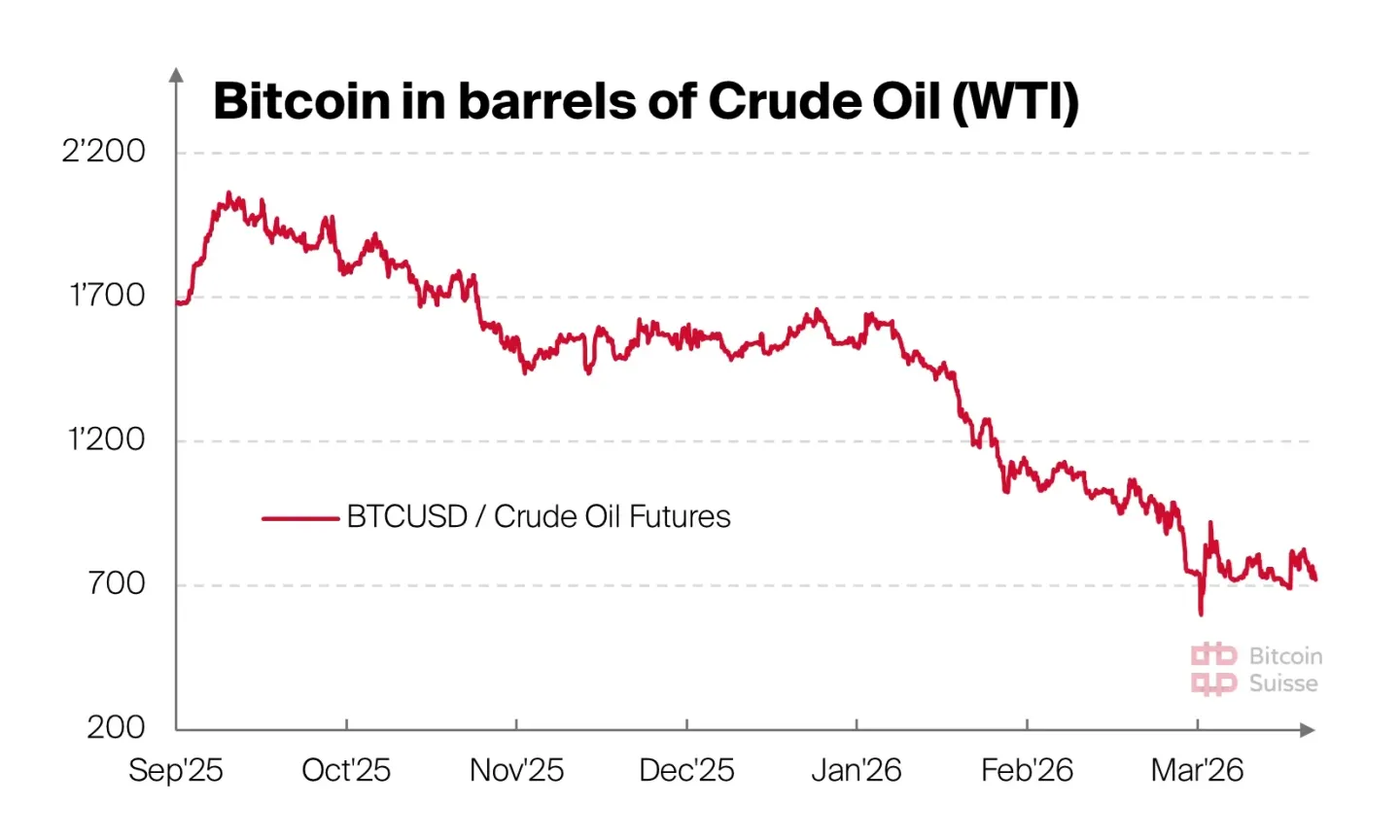
Chart of the Week: The Price of Bitcoin in Barrels of Crude Oil (WTI)
As oil is among the most discussed and most traded commodities in the world currently, amid the war in Iran, we decided to take a look at Bitcoin priced in barrels of crude oil (WTI) in our chart of the week below. Bitcoin is down significantly compared to the price of oil. Of course, Bitcoin’s performance against the USD also played its part, but the increase in oil prices itself also contributed to this dynamic. Bitcoin is currently down 65 percent against oil since September, which is a lot worse than its 46 percent loss against the USD. There was a short sideways period from November to the end of January, and Bitcoin appears to be consolidating again right now. But this should be taken with a grain of salt, since it is currently impossible to predict what will happen between the U.S./Israel and Iran and how it could impact the oil market. It is certainly a chart to keep in mind over the coming weeks.