

• Home
  • Industry Blog
  • Is the Bitcoin Bear Market Over? Eight Conditions, One Open

Is the Bitcoin Bear Market Over? Eight Conditions, One Open

Dominic WeibelHead of Research, Bitcoin Suisse
22 Sep 20267 Min

On October 10, 2025 the market broke to the downside, marking the beginning of the recent Bitcoin bear market. In August, we had a similar liquidation in the opposite direction, when almost 20,000 BTC of short positions, approximately $1.5 billion, closed out between August 19 and 28. 

The similarity is quite striking, and in our view these liquidation shocks may mark both ends of the crypto bear market. However, a liquidation is still an event rather than evidence. In our September Industry Rollup, we set out the eight conditions that sustained the decline and asks which of them still hold. Seven no longer do.

Bitcoin’s buyers are back 

Two of the eight concern demand, and the first is relatively straightforward. For most of the year there was no macro catalyst and nothing obliged anyone to reprice, until August 19, when the Treasury said it would at least double its long-end bond buybacks. Long-dated yields came down, hard assets bid, and the scarcity trade was back.  

Flows arrived behind it, which settles the second. The first half of 2026 was the first negative half-year for U.S. spot Bitcoin ETFs since launch, and July added only $240 million on inflows where August drew $3.7 billion of Bitcoin ETF inflows. A third condition turned with them. Bitcoin liquidations amplified every move lower through the decline, and in August the same mechanism supplied the accelerant on top of the catalyst instead.

Reclaiming the cost basis clears the first hurdle 

That rally had to move through levels where earlier buyers were trapped. Bitcoin spent the decline below the cost basis of its major buyer cohorts, which was the fourth condition, and it has now reclaimed the most important of them.  

The short-term holder cost basis, meaning the realized price coins held for less than five months, has been one of Bitcoin's most reliable medium-term trend indicators over the past decade, and reclaiming it near $71,000 returned recent buyers to profit. When this occurs after a bear market it has usually been the first hurdle cleared toward a trend reversal. It should now provide support. 

Selling had also overwhelmed whatever demand there was, which was the fifth condition. Seller exhaustion has now met returning spot demand, and in our view Bitcoin would need to trade much higher to find sellers again.

Measuring this bottom against previous Bitcoin cycles 

Two further conditions concern the shape of the bottom itself. The first was an incomplete bottom setup. Our bottom framework, built by Filippo Franchini, accumulates signals across a bear market rather than requiring them to activate all at once. Institutions have changed the dynamics we are familiar with in Bitcoin, and the concentrated capitulation that once set them off together is less likely to arrive. It now reads 89% of available bottom signals against 78% at the estimated July low. But it is not a timing model, and bottom regimes can take months to resolve. 

The second was that the drawdown looked too shallow to mark a cycle low. Previous cycles saw drawdowns near 80%, and this one has been much shallower and much shorter. A growing share of supply now sits in institutional vehicles and corporate balance sheets rather than with miners, whose issuance has become less relevant to the clearing price. Less of the float is obliged to sell into weakness, which is why the decline stayed shallower, and in our view that is one of the big fingerprints of cycle maturity. Measured against Bitcoin's long-term trend rather than against the peak, the reset was still one of the deepest we have seen. 

Bitcoin’s four-year cycle points to a low in October, although it defines a blurry window rather than a date. Once many investors use a signal it decays in alpha, and many of them remain sidelined and underallocated because they are waiting for the bottom the cycle told them to expect. In our view, the cycle may finally break.

What bear market condition has not reversed? 

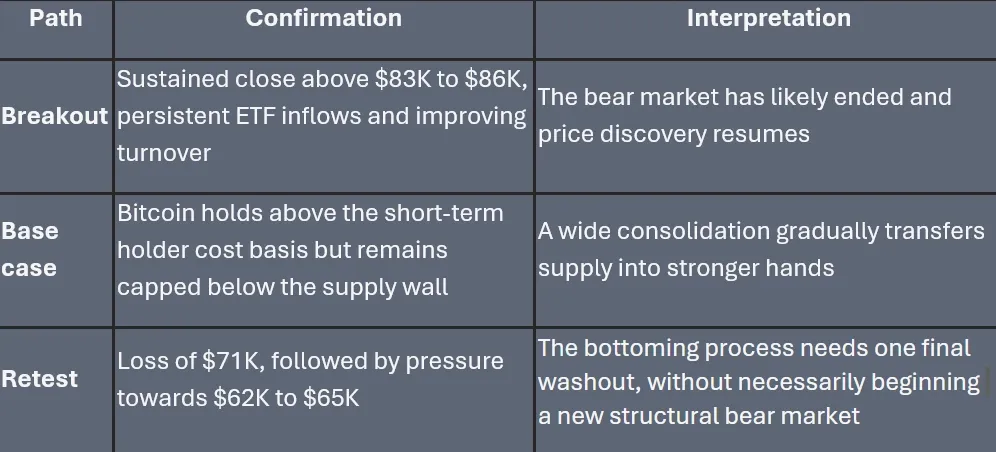
That leaves one condition standing. There is still no trend confirmation, and it sits above the market. As of the Rollup's September 2 cutoff, the short-term holder cost basis near $71,000 marks support, while the ETF investor cost basis near $82,000 is the bears' last stand in our view, with $83,000 to $86,000 defining the last resistance above it.  

Reclaiming that zone in a sustained fashion is the last checkmark we need, and it would make a structural bear case very hard to justify. Whichever side breaks first is likely to define the next trend. Another deep drawdown cannot be fully ruled out, but a durable bear market is no longer our base case. 

Getting there may take time. Bottoming and breaking out are two different events, September usually brings seasonal weakness, and midterm election years have historically been rougher still through September and October, although they have usually finished the period higher. Expect some volatility over the next two months, without taking a drawdown as evidence of a new low. A retest would not invalidate the view that the low has formed, but losing the deeper accumulation range would.

Three paths for Bitcoin from here 

Between those levels sit three ways this could resolve.

The low is likely behind us, even if the path remains hostile. As the Rollup puts it, the four-year cycle is waiting for sellers who may no longer exist. 

The full September Industry Rollup covers this section in detail, alongside the month's market performance, macro indicators and key crypto developments.

Image is AI generated.

Related Articles

  • Market Insights

    Is the Bitcoin Bottom In? What 19 On-Chain Indicators Say About This Bear Market

    The August 19 pump brought a lot of mixed sentiment. Bitcoin went from the low $60,000 range to above $80,000 in a matter of days, fueled by a massive Bitcoin short squeeze, renewed ETF inflows, and a U.S. Treasury decision to double long-end bond buybacks.

    26 Aug 20267 Min
  • Market Insights

    Why Is Crypto Down While Stocks Are Up?

    Why is crypto down while stocks are up in 2026? Bitcoin Suisse breaks down the Warsh effect, gold's recoupling with crypto, and the H1 2026 asset divergence.

    18 Aug 20267 Min
  • Market Insights

    What the Coldcard Exploit Means for Crypto Wallet Security and Custody

    The Coldcard exploit drained 2,000+ BTC from 7,000+ wallets. What it means for crypto wallet security, bitcoin self custody, and institutional crypto custody .

    7 Aug 20267 Min

Personal Support, Every Step

Our team of native experts are here to provide you with the tools, insights and support you need.

Opening hours

24/7 online

Monday to Friday: 7am to 7pm

contact@bitcoinsuisse.com

0800 800 008

Call us toll-free from Switzerland

+41 41 660 00 00

Call us from abroad